Descrizione
BRUSTOLON, GIOVAN BATTISTA (Dont di Zoldo 1718 – Venice 1796) – A couple of beautiful engravings depicting venetian landscapes:
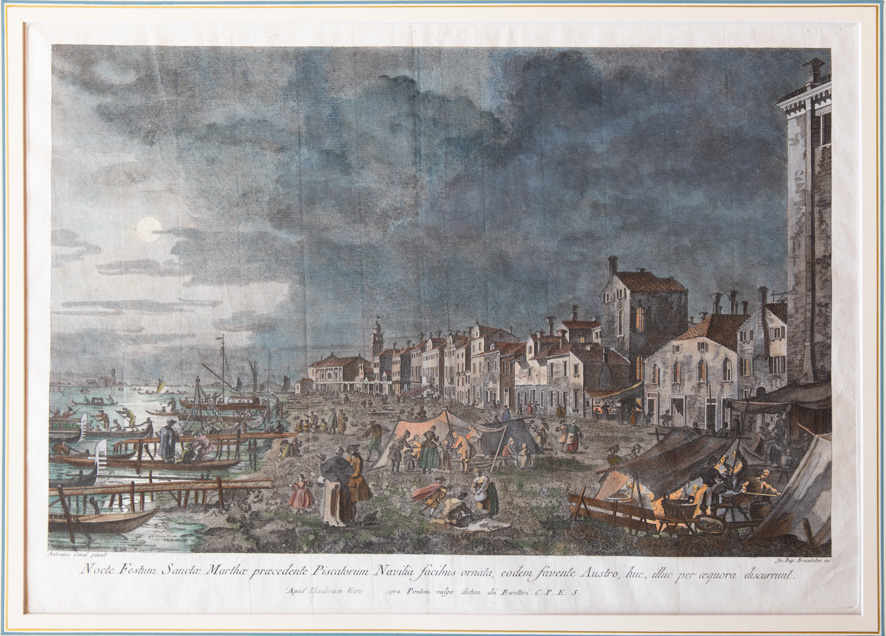
1) “Nocte festum Sanctae Marthe praecedente piscatorum navilia facibus ornata, eodem favente Austro, huc, illuc per aequora discurrunt. | antonius canal pinxit | jo. Bap. Brustolon inc. | apud Theodorum Viero supra pontem vulgo dictum dei baretteri c.p.e.s.”. Single sheet, etching and engraving in full color (plate: 325×460 mm – sheet: 408×565 mm) Watermark “three half-moons”. Whole sheet with original margins (visible a couple of small pinholes in the left margin), all in very good condition. (With:)
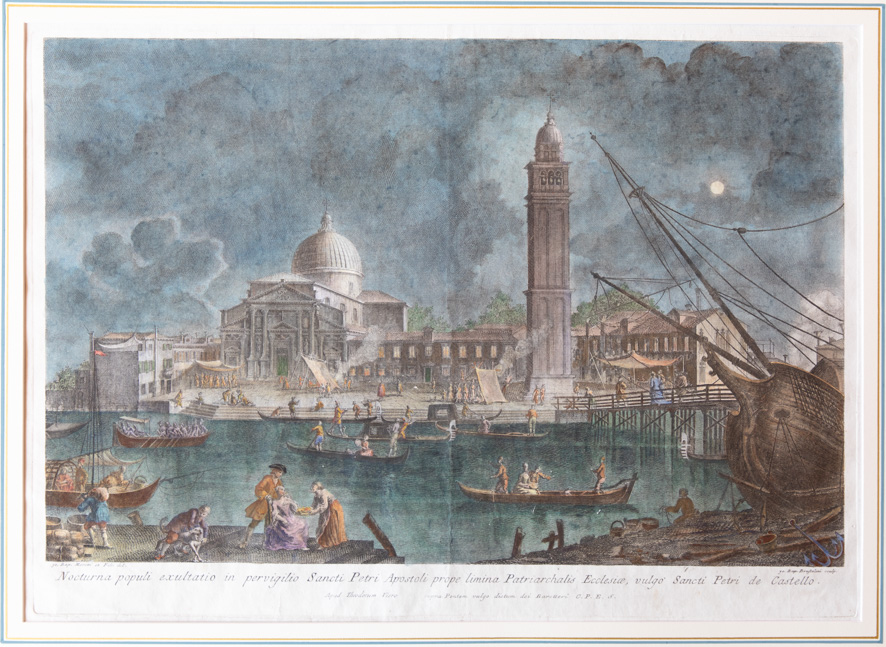
2) “Nocturna populi exultatio in perviglio Sancti Petri Apostoli prope limina patriarchalis ecclesiae, vulgo Sancti Petri de Castello. | Jo. Bap. Moretti et Filii del. | Jo. Bap. Brustolon sculp. | apud Theodorum Viero supra pontem vulgo dictum dei Baretteri c.p.e.s.”
Single sheet etching and engraving in full color (plate: 324×455 mm. – sheet: 405×565 mm.)
Whole sheet with original margins., two small restored tears in the lower margin; two flaws in the right lower corner and one at left.
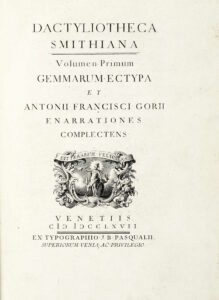
Brustolon was born in Dont di Zoldo, province of Belluno, circa 1718. In 1733 he became resident of Venice and began working as an engraver in the workshop of the printer Guglielmo Zerletti. He was active in the field of book illustration, where we find his first publication in a book published in 1745 by Francesco Pitteri (frontispiece and three cartoons of Memorie istoriche, critiche e morali concernenti la vita del beato Giordano Forzatè di Nicolò Costantini). Of the many works that followed, it is worth remembering the seven engravings included in ‘Le rime del Petrarca brevemente esposte per Ludovico Castelvetro’ by the publisher Antonio Zatta in 1756 and the one hundred tables depicting gems and cameos contained in the ‘Dactyliotheca Smithiana’, published by Giambattista Pasquali in 1967 (also present in this catalogue, item n. 42). But it is in the ‘Vedute’ that Brustolon expressed his best art which made him one of the leading characters of eighteenth-century venetian Vedustismo . His most significant work was published in 1763 by the publisher Lodovico Furlanetto: “Prospectuum aedium, viarumque insigniorum urbis venetiarum…” It was conceived as a series of twelve prints after designs by Antonio Canal, “il Canaletto”, engraved by Antonio Visentini and published in 1742 (see the item n.4 in this catalogue) which Brustolon copied in a larger size.
In 1766 the publisher Furlanetto obtained a twenty-year privilege (a sort of copyright) from the Venetian Senate concerning the most famous and spectacular series of engravings by the artist: the “Feste Ducali”, twelve plates derived from Canaletto’s watercolor drawings. These twelve prints can be considered Brustolon’s masterpiece and a momentous in the history of Venetian engraving. Brustolon perfectly interprets the pictorial model, knowing how to render the transparency of Canaletto’s skies and the luminous brilliance of the architectures with an elaborate using of chiaroscuro and an impeccable perspective. Most of all, in 4 prints of the series he was able to express with remarkable virtuosity the magical atmosphere of nocturnal festivals and parties in the moonlight as it’s evident by the two of them presented here.
LA SAGRA NOTTURNA DI SANTA MARTA. (THE NOCTURNAL FEAST OF SAINT MARTHA).
The print depicts the feast, or eve, of St. Martha’s Day, a popular festival that was celebrated the night before
the anniversary of the saint, the 29th of August, along the northern bank of the Zattere, a neighborhood of poor
fishermen. The scene takes place on the arzere (embankment) of Santa Marta, in front of the eponymous church
that once stood there and who can be seen in the background of the composition. It was a popular celebration in which all different social classes, even the wealthiest, took part. The crowded party illuminated by the full moon and the bustle of the fishermen on the shore is rendered with great suggestion. As indicated in the caption
(ANTONIUS CANAL PINXIT) Brustolon engraved the plate copying directly from a painting by Canaletto that was part of a series of 4 views commissioned by the collector Sigismund Streit. The painting is currently in the collection of the Staatliche Museen of Berlin. In the caption we notice that the editor is no longer Furlanetto, whose twenty-year copyright had expired in 1788, but Teodoro Viero, who indeed reprinted the series in 1791 (APUD THEODORUM VIERO SUPRA PONTEM VULGO DICTUM DEI BARETTERI C.P.E.S.). Since the address of Lodovico Furlanetto is partially erased here, citing only the name of the new publisher (but still with the address of the previous one), we can assume that the print is in the third state.
LA SAGRA NOTTURNA DI SAN PIETRO IN CASTELLO. (THE NOCTURNAL FEAST OF SAN PETER IN CASTLE).
The feast of San Pietro in Castello was celebrated on the night of 28 June, Saints Peter and Paul’s eve, near the island of San Pietro in Castello, when the church was the Cathedral of the Patriarchate of Venice. It is one of the most peculiar festivals of the city, established in memory of the victory of Doge Pietro Tribuno over Ugri Tartars in the year 888. In this case, as stated in the caption (JO. BAP. MORETTI ET FILII DEL.), the etching derives from the preparatory drawing by Giovanni Battista Moretti, now kept in the Ashmolean Museum in Oxford. In effect, the print presents some differences compared to Canaletto’s painting, which, as in the previous case, was one of the four views commissioned by Sigismund Streit, now at the Staatliche Museen in Berlin. However, the suggestion of the beautiful night scene created by the painter, where the light of the full moon that filters through the clouds illuminates the canal, remains unchanged. Again, like its pendant, this engraving also bears the name of the new publisher, Teodoro Viero, but still with the address of Lodovico Furlanetto, (APUD THEODORUM VIERO SUPRA PONTEM VULGO DICTUM DEI BARETTERI C.P.E.S.) we assume that it is in the third state too.