Descrizione
RUBENS, PETER PAUL – Palazzi moderni di Genova raccolti e designati da Pietro Paolo Rubens. In Anversa presso Giacomo Meursio, 1652. (Bound with:) Palazzi Antichi di Genova … di P. P. Rubens. Antwerp, J. Meursius, 1652.
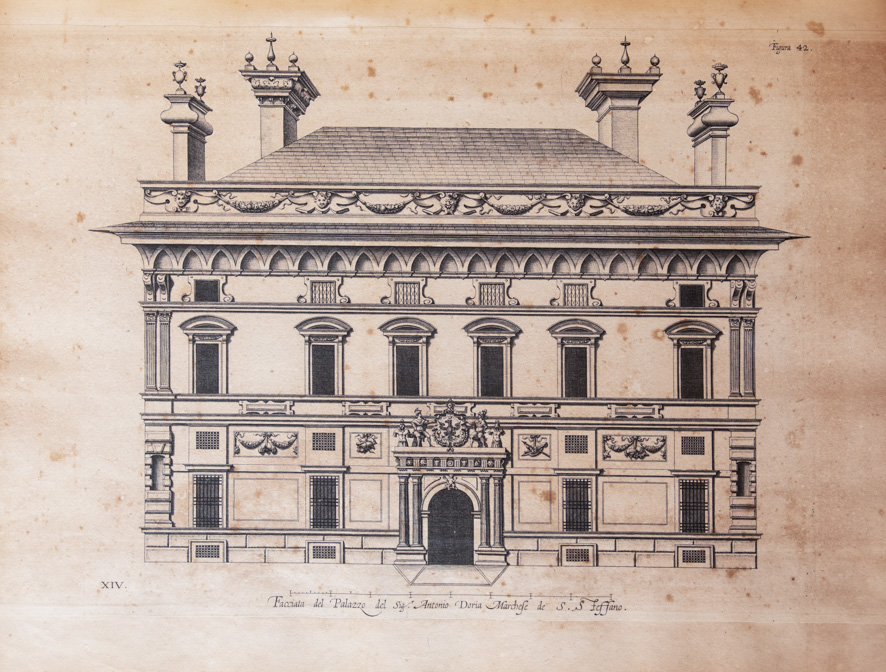
Large folio (440×343 mm.), two parts (the ‘Palazzi Antichi’ bound after the ‘Palazzi Moderni’) in one volume in contemporary brown calf, gilt spine with raised bands, spine carefully rebacked in the 19th cent., hinges redone, corners of board restored. Generally, some browned or foxed inside, of variable intensity, for the quality of the paper; all the plates of the ‘Palazzi moderni’ with margins extended at an early time – likely when the binding was done – in the way to match them with the following part of the ‘Palazzi antichi’; title-leaf backed, the lower corner repaired, creasing at first 3 leaves. Two title-pages, each with large engraved vignette by Cornelius Galle from a drawing by Rubens. Pt. ‘Moderni’: pp. (4), with 67 engr. plates (also double-page); Pt. ‘Antichi’: pp. (2), with 72 engraved plates.
Second edition (the first after the painter’s death) of the work on Genoese palaces composed by Rubens during his Italian period; it is a homogeneous collection of reliefs on the villas and palaces of the city. Court painter of Vincenzo Gonzaga in Mantua, and diplomat in Spain for both the Gonzagas and the Spinolas, Rubens was several times in the Genoa, even if the opportunity to deepen his study of the main palaces of the city was in 1607, during a Duke Vincenzo’s summer stay in Genoa. Rubens published the volume on ancient buildings for the first time (1622) at his own expense, the buildings were represented with the letters of the alphabet from A to K and only two (with less plates) have the indication of the owners (Palazzo Tursi and Palazzo Pallavicino Cambiaso ). For the second edition, it was decided to publish all the other palaces in a numerical sequence which favors neither the supposed historical dating nor the possible common stylistic characteristics, but reports the names of the contemporary owners. The work had various vicissitudes, so much so that today there are even two “first editions”, whose history is still controversial. Meurs, in the 1652 edition, arranged the tables under two distinct title pages “Ancient palaces” for the first part and “Modern palaces” for the second. Mario Labò writes: “How Rubens obtained the material for the book, how he collected all these drawings, has been a mystery up to now. Within certain limits, in his preface, he initiates an answer by declaring that he had collected the drawings ‘in Genoa with some effort and expense and no good confirmation of being able to take advantage in part of the other people’s efforts’. It should be understood that something he drew, something he had drawn, and furthermore he was able to make use of ready-made drawings by others […]; he came to Italy with Deodatvan der Mont, one of his pupils in painting, four years younger than him, and skilled in architectural drawing […] the drawings are poor … but with a confident style [. ..]. Many drawings bear instructions, suggestions that the engraver used, accentuating the chiaroscuro with skilful punctuation and hatching, and the diversity of materials … Genoese dialectal forms abound in the inscriptions […]. Evidently, while he was in Genoa, he chose the palaces, hired the draftsmen, and gave them orders so that they could send him the drawings to Flanders”. Fowler, 227, notes that “most authorities agree that the second series of plates was not the work of Rubens”. Cicognara, n. 4084; Berlin Kat 2657 (1° ed. 1622); UCBA II, 1787.