
Descrizione
PIRANESI, GIOVANNI BATTISTA – Lettere di giustificazione scritte a Milord Charlemont e a’ di lui agenti di Roma … intorno la dedica della sua opera delle antichità Rom. fatta allo stesso signor ed ultimamente soppressa. Rome: s.n.t., 1757.
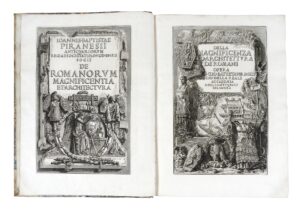
Small folio (275×185 mm.), late 18th cent. wrappers made with colored paper, a clean and well-preserved copy with good margins (light marginal foxing to the plates). Engraved frontispiece, pp. numb. XXVIII (with 4 engraved headings and 1 engr. tailpiece), and at the end 7 (of 8) engraved plates by Piranesi, 1 folding, lacking Pl. IV. In some copies is present an engraved presentation leaf at the beginning (depicting a border of architect’s instruments against a laurel wreath), where it had to be written the name of the dedicatee, as Piranesi was used to give this booklet as a present to the buyers of the “Le Antichità romane”, to which this work is strictly linked (i.e. the copy of the BNF in Paris visible on gallica.bnf.fr is lacking too the dedicatory leaf). The missing plate here is depicting a colonnade, titled ‘Quarto frontespizio’ in the inscription at bottom of the copperplate (so one of the title-pages originally dedicated to Charlemont).
First and sole edition, rare, of this highly controversial work by Piranesi created to document the disagreement he had with the noble James Caulfield, Earl of Charlemont, who was initially a patron and economic supporter of the author’s publications; the viscount, despite his promises, did not grant Piranesi the promised patronage for the publication of the “Antichità romane” (1756).
The Irish nobleman and politician James Caulfield, first Earl of Charlemont (1728-1799) was a patron of the arts, and friend of Burke, Johnson, Reynolds, Goldsmith and Hogarth. Educated privately, he went abroad at the age of eighteen in 1746, travelling to Turin (where he resided for a year, making the acquaintance of David Hume), Rome, the Greek Islands, Constantinople, the Levant, and Egypt, before returning to Ireland in 1754. During this time, he became a sponsor of Piranesi, whose ‘Camere sepolcrali degli antichi romani le quali esistono dentro e fuori di Roma’ (c.1750) was subsidised by and dedicated to Charlemont; Piranesi engraved a large number of additional plates, and – having secured a promise of further subventions from Charlemont to offset the significant financial outlay involved – added them to the work, publishing the four-volume set under the title Le Antichità romane in 1756. However, by this point Charlemont had returned to Ireland and, despite repeated requests from Piranesi, did not provide the artist with the anticipated payment but only a sum of less than 200 scudi, a figure which Piranesi dismissed as offensively small (in contrast, the Pope had given 1,200 scudi without any expectation of a dedication). In frustration and anger, Piranesi removed the dedications to Charlemont present on the first states of the title-pages to the work, and scrupulously expunged all references to his erstwhile patron from the text. As Wilton-Ely states, “the intellectual and social changes of the late 18th century affected the traditional relationship between patron and artist, and the ‘Lettere’ are symptomatic of issues greater than a mere personal quarrel. For Piranesi, deeply involved in the study of Roman civilization, the creative act of recording the achievement for posterity conferred on him a dignity worthy of his patron’s respect” (p. 802).
The textual vindication of his position is complemented by the series of eight plates which demonstrate the disassociation of Charlemont’s patronage from the work in a relentlessly methodical manner; they illustrate the original title-pages with their dedications to Charlemont (plates I-IV), two versions of Charlemont’s text for the dedication leaf (plates V-VI), the first title with the dedicatory text erased (plate VII), and, finally, the second state of the title-page with the revised dedication (plate VIII). The title-page of the Lettere exists in two early states: with a quotation from Ennius (as here) and with a quotation from Pliny; Wilton-Ely posits that the first state was for copies “circulated to influential people of rank while the second one was intended for Piranesi’s artist friends and collaborators, especially among the British colony at Rome” (p. 803).
Hind p. 84 (“The volume was suppressed soon after publication which accounts for its extreme rarity”). BAL RIBA 2560; Berlin Katalog 1879; Cicognara 3830. Etched dedication leaf [W.-E. 739], title-page [W.-E. 738, state one of two early states], and 8 plates, one double-page and folding [W.-E. 745 (early state)-752]. 4 headpieces [W.-E. 740-743] and one tailpiece [W.-E. 744], by and after Piranesi.