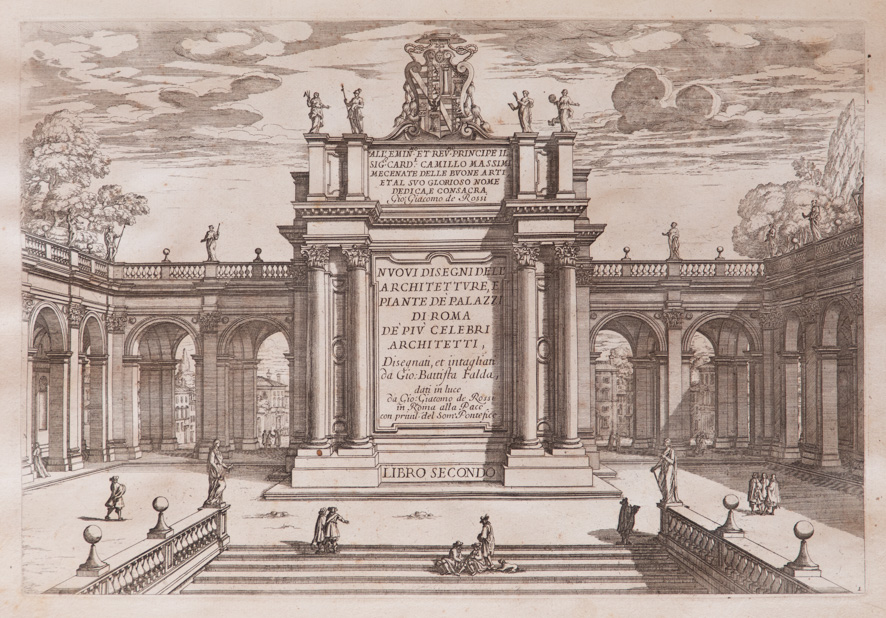
Descrizione
FERRERIO, PIETRO and FALDA, GIOVANNI BATTISTA – Palazzi di Roma de più celebri architetti … Libro primo. [Rome:] Giovanni Giacomo De Rossi, s.d. [c. 1691]. (Bound with:) Nuovi disegni dell’architetture e piante de’ palazzi di Roma de’ più celebri architetti … Libro secondo. Rome: Giovanni Giacomo (and Domenico) De Rossi, s.d. [c. 1691].
Folio (441×328 mm.), late 18th cent. half brown calf, with corners, gilt spine with title in gold on red morocco label, boards covered with green marbled paper (some rubbed), internally light browning or foxing here and there, generally in good, clean conditions, margins a bit short. Engraved nobiliary bookplate at inner side of front cover, a faded stamp on first title. Ferrerio, 1st part: Altogether 44 engraved plates, including the architectural frontispiece with title engraved in a cartouche held up by the allegories of painting and architecture, surmounted by Cardinal Antonio Barberini’s coat-of-arms, being the dedicatee of this work. Falda, 2nd part: Altogether 61 engraved plates, including the architectural frontispiece depicting a colonnade and a large portal, containing the title and the dedication to Cardinal Camillo II Massimo.
The definitive edition, here in the first issue, with the plan of the Collegio Romano (pl. 44 of part I) and that of Villa Borghese (pl. 27 of part II) which were added only after 1690 by Domenico de Rossi, son and heir of Gian Giacomo. Further, the captions of plates 28 and 29 (in part II) are still attributing the ownership of the building located in Piazza S. Marco in the Pigna borough to the d’Aste family, a building which will later be purchased by the Marquis Rinuccini. Rossetti 4975 (no mention of different issues). “The first publication to provide systematic, measured, and uniformly scaled illustrations of Roman Palaces built between the 15th and the 17th century” (Millard, IV, page 126). Ferrerio linked his celebrity mostly to this book, as author of the drawings (the engraver is still unknown), giving more space to the Renaissance architects, like Bramante, Raffaello, Bald. Peruzzi, Michelangelo, Vignola, Ammannati, Ligorio, but quite less room to the contemporary architects like Bernini, Borromini or Domenico Fontana. Giovanni Battista Falda (1643-1678) began his artistic career as a very young pupil of Gian Lorenzo Bernini, but the meeting with Giovan Giacomo De Rossi and the apprenticeship carried out in his printing house turned his career in the engraving, in fact he worked practically throughout his short life with De Rossi.
The printer Giovanni Giacomo de Rossi (active in Rome between c. 1638 and 1691), was the initiator of the artistic and commercial fortune of the de Rossi family, able to turn an artisan workshop (inherited from his father, Giuseppe) into a workshop of almost international dimensions, becoming the largest producer and merchant of prints in Rome – so a tireless provider of prints for the Grand tour(ists) – and giving such trade a hitherto unknown dimension, then carried on by his son Domenico (1659-1730) who significantly contributed to the diffusion of the Baroque style throughoutEurope. Fowler 120; Berlin Kat. 2665; Brunet II, 1235; Cicognara 3719.