Descrizione
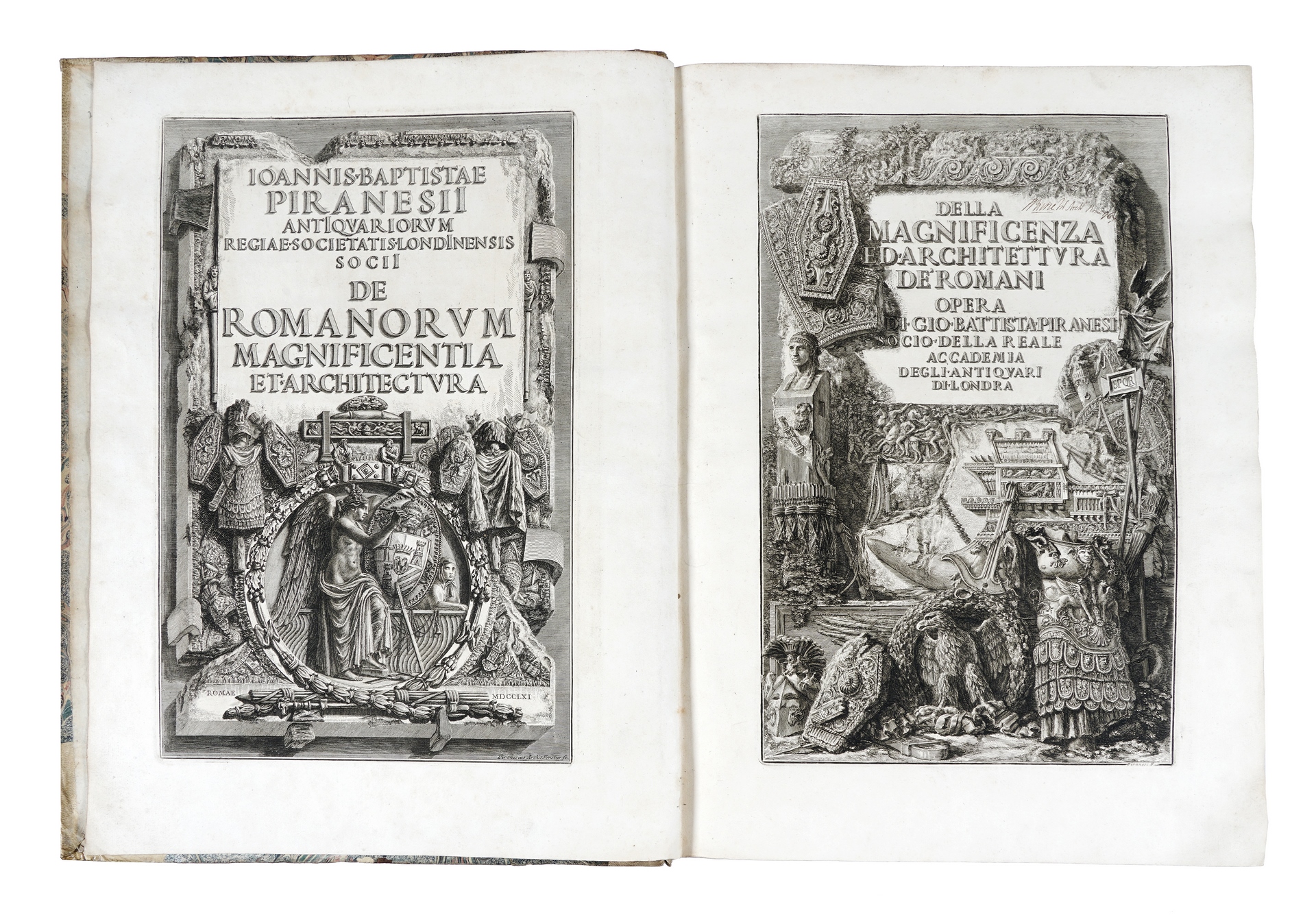
PIRANESI, GIOVANNI BATTISTA – Della Magnificenza ed Architettura de’ Romani, Opera di Gio. Battista Piranesi socio della Reale Accademia degli Antiquari di Londra. Rome, 1761. (With:) Osservazioni … sopra la lettre de M. Mariette aux auteurs de la Gazette Littéraire … [Rome], 1765.
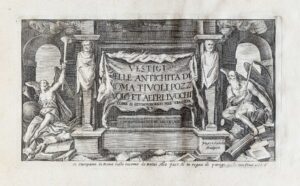
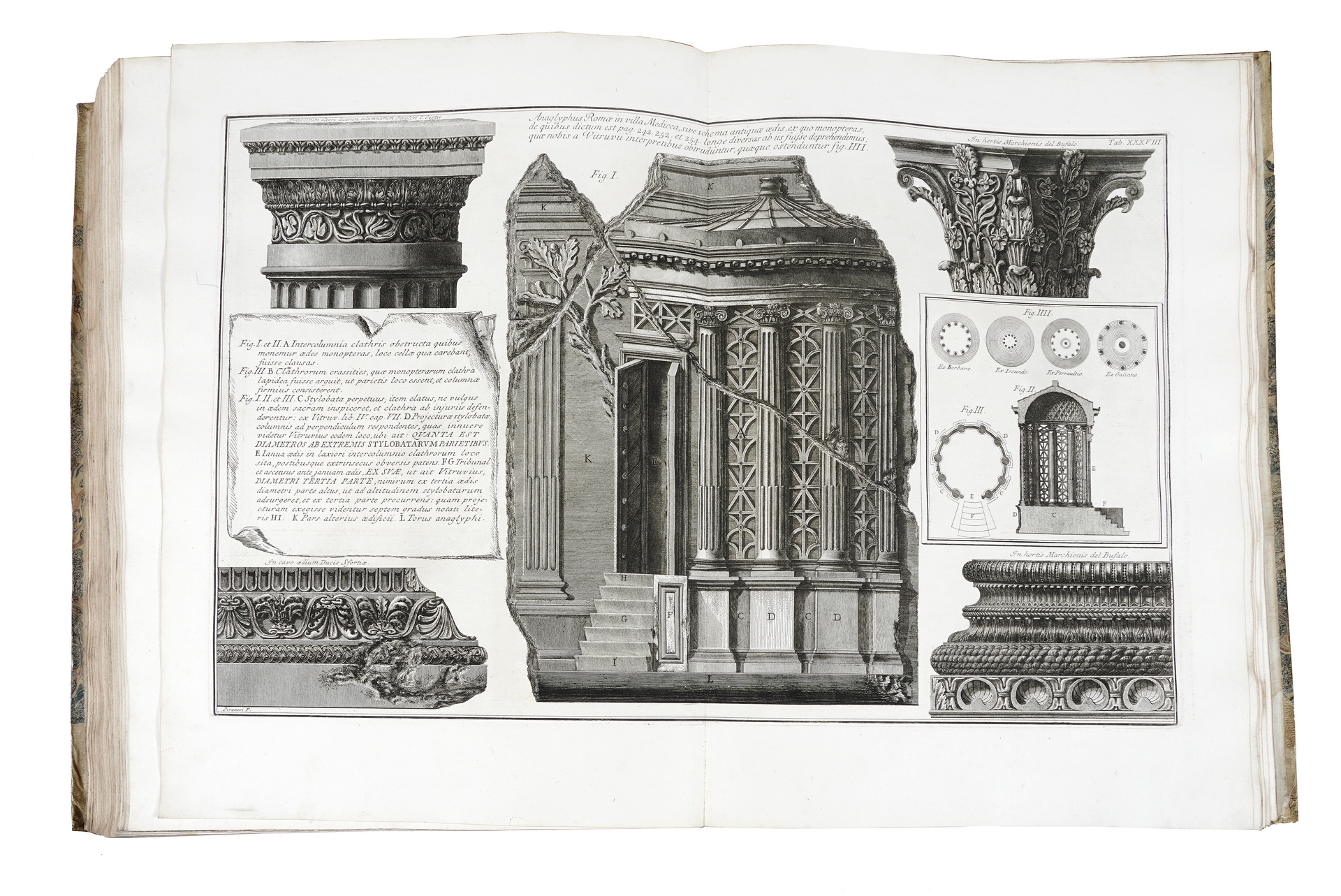
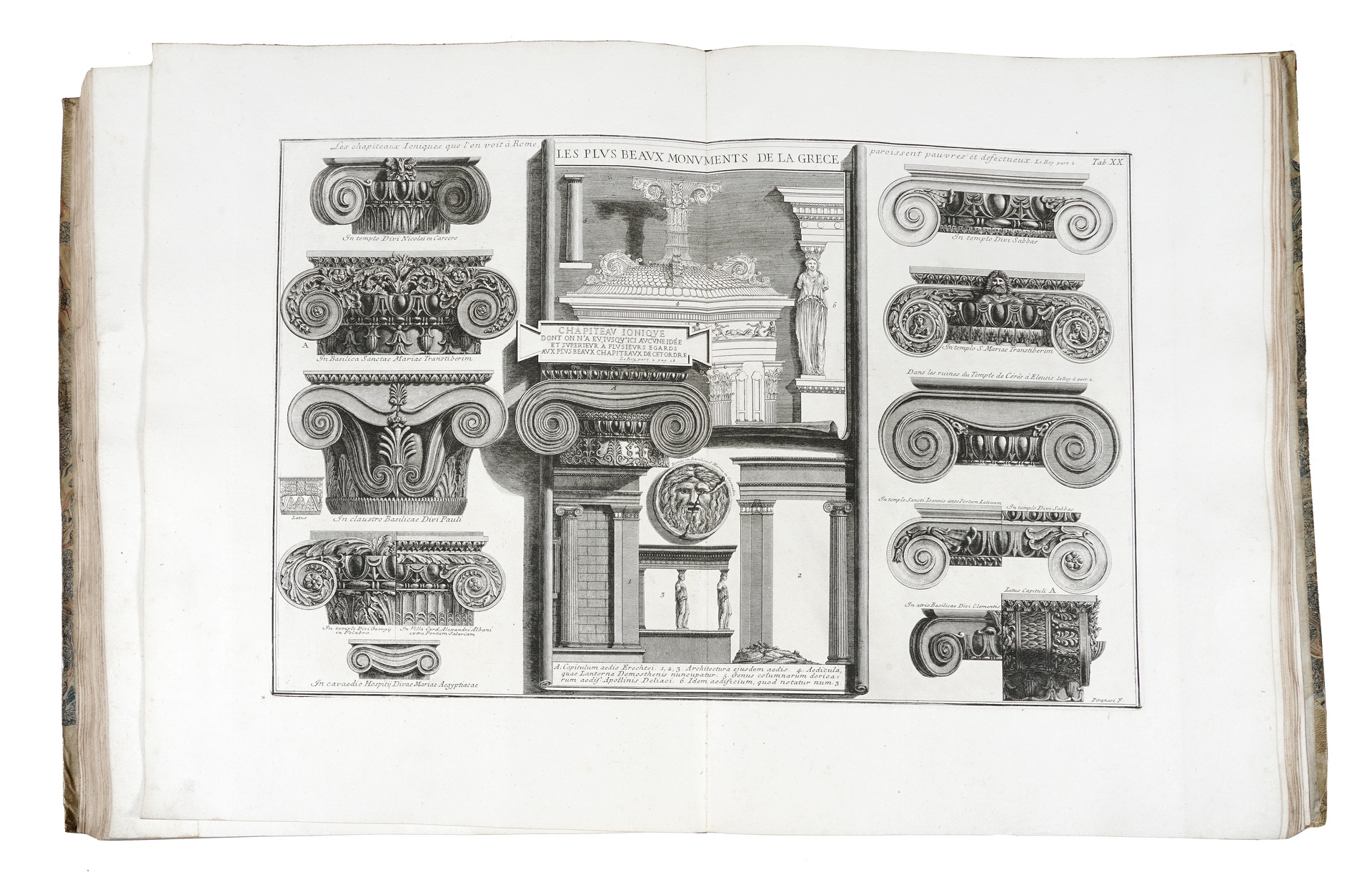
Large folio, 2 works bound together in contemporary half vellum with corners, marbled paper on boards, title in gold on red morocco label, spine a little worn, internally a very good copy with excellent impressions, printed on thick laid paper, a copy with distinguished provenance, James Paine’s copy with his ink inscription “J. Paine S. A. Rome 1767” to title of first work and on front free endpaper (occasional light foxing to text of first work but plates very clean). Magnificenza: Engraved architectural frontispieces, in Latin & Italian, with a full-page portrait of Pope Clement XIII, text in Latin & Italian on facing leaves, 38 engraved plates, 8 double-page and 4 folding, engraved pictorial initials and 2 illustrations, pp. (2), CCXXII. Osservazioni: engraved architectural frontispiece, and 9 engraved plates, 6 double-page, no printed text here (as never bound in, plate 1 bound upside down and with tiny scratch to image).
First edition of Piranesi’s lavishly illustrated contribution to the Graeco-Roman debate of the period, inspired by the publication of the work by Le Roy, who in his “Les ruines des plus beaux monuments de la Grèce” implied that Roman art was an imitation of the Greek one. Piranesi replied resting his main defence on the Etruscan as being not only an older and more gifted race than the Greeks but also the first instructors of the Romans, and so on outlining his theories regarding the originality of Italy over Greece. As a response to Piranesi’s theories in the ‘Magnificenza’, in 1764 the French critic Mariette published an article in the ‘Gazette Littéraire de l’Europe’, rejecting the claims of the Etruscans’ originality on the grounds that they had been Greek colonists, so that all Roman art derived from that of Greece; this generated a reply by Piranesi, the second work bound here, the ‘Osservazioni’, where he refuted Mariette thesis sentence by sentence.
James Paine the Younger (1745-1829) was the son of James Paine the architect (1725-1789), studied at St. Martin’s Lane Academy, and in 1764, aged 19, he went to Rome for the first time – so in the classic tradition of the Grand-Tour – and though he was back in England by 1769, in 1774 he was again in Rome, this time accompanied by his wife. He seems to have remained in Italy for at least nine years, known for having subscribed various books, giving his address as “Rome”, up till 1783. By 1788, however, he had returned to London. Paine was well known as a maker of chimney-pieces and also in the Victoria and Albert Museum are a number of his designs for these. On 12 March 1830 Christie sold the pictures, casts, books of architecture, and other items “The property of J. Paine, Esq., Architect (deceased)”. Among them, a large volume with “J. Paine, jun. Archit. Rome, 1774”, on the outside, containing 57 drawings of studies at Rome, all signed by him (plans of four palaces, views at Albano and Tivoli, measured drawings of the Ponte Rotto, and a number of statues with their measurements), went in time to the South Kensington Museum.
Hind, pp.84-5; Wilton-Ely, pp.820-866; Focillon 927-966; BAL RIBA cat. 2552; Osservazioni: Focillon 967-982; BAL RIBA cat. 2563; Wilton-Ely, pp.867-884.