
libri antichi, incunaboli e manoscritti
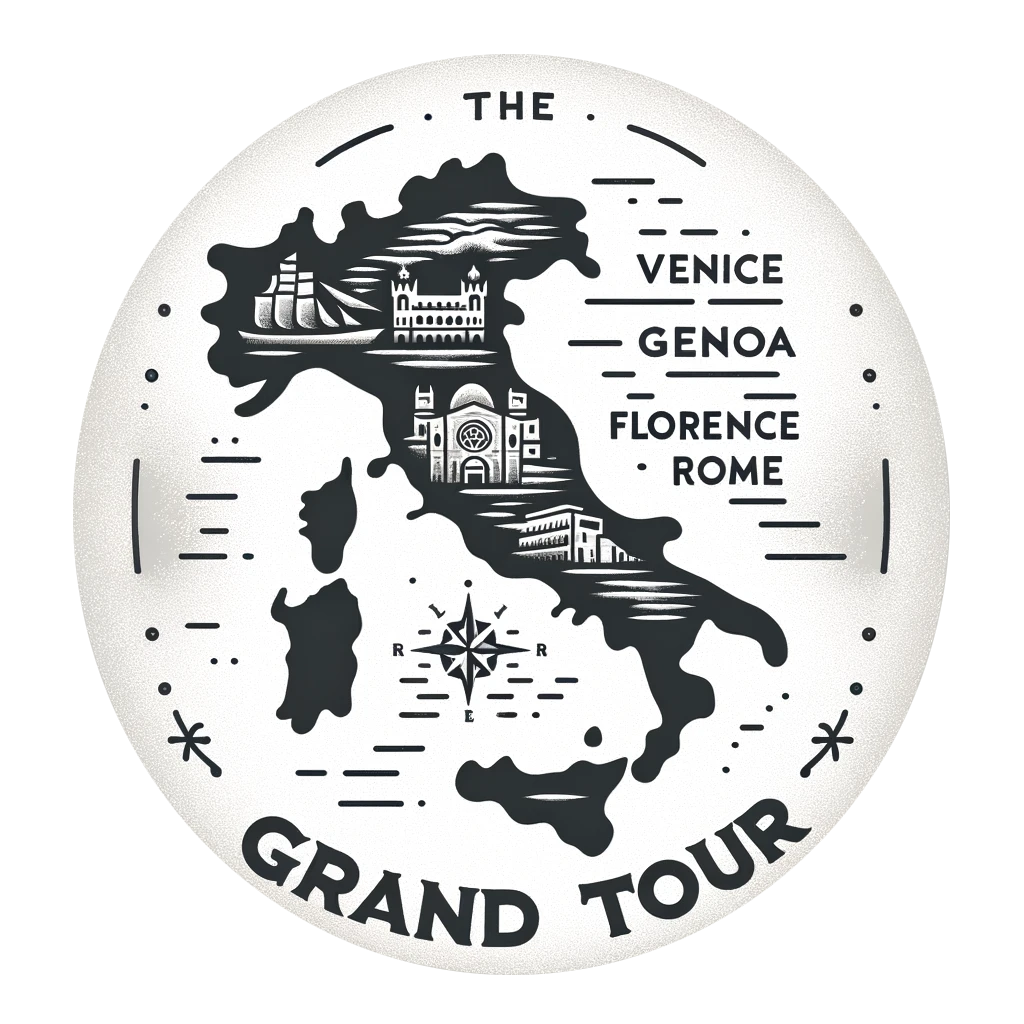
THE GRAND TOUR
Since the end of the 16th century, travelling has been a vital part of the scions of the wealthiest families’ education, indeed it can even be said that it represents the most important source of unpredictable experiences and a privileged means of empirical understanding of the world. It is a pathway which not only draws a single itinerary on the map, but also concerns the personal and emotional growth of the travellers themselves, who weren’t much more than teenagers. Very often accompanied by tutors and servants, these young people departed, usually from northern Europe, passing through the main capitals of the continent to finally arrive in Italy, in where they would dedicate most of their time to a “grand tour”.
Already in this time “il Bel Paese” represented the land of the great antiquarian tradition, the garden of delights where the grandiose and majestic ruins of ancient times could be contemplated with amazement. Here, the first “guides” were already outlined, which, emphasizing the extraordinary pedagogical potential of the travels, recommended a long list of places and monuments to visit. Such as Francis Bacon’s Of Travel, which is part of his Essays of 1597, and that remained an undisputed source and guide for at least two centuries.
However, it was only in the 18th century that travelling to Italy reached its golden moment; during the Enlightenment, in fact, the spread of the tradition was unstoppable. This phenomenon completely transformed the meaning of the Grand Tour as an inescapable attraction to the ancient and a calling to the sublime, no longer appealing only to young people in search of an initiation, but to writers, artists, men and even women, albeit few, of undoubted taste and culture, all sharing the search for emotions and suggestiveness that only the Italian landscape seems able to offer.
It is precisely during this period and most importantly at the turn of the century, when the passion for ancient ruins bursts and the new Neoclassical current is imposed, that artists and engravers applied their craft to developing projects for the use and consumption of travellers, eager to bring some of that enchantment back to their homeland. It was then that small and large works of art were born, publications of views and architectural drawings of Rome, such as those by Vasi; or snapshots of a city in perpetual motion like Venice, as in the works by Marieschi; or even the visionary Piranesian engravings, where man becomes minuscule in the face of the majestic and imposing vestiges of the past.
Alongside these extraordinary works there was a copious production of objects in micromosaic, glyptic, bronze, precious marble and even porcelain, to offer small copies as delightful compendiums of grandiose monuments. Travellers themselves felt the need to fix the images of their own Italian experience onto paper, at times with detailed travel journals, other times with naïve sketches which nonetheless do not lack a certain elegance. And even when the diary is the work of a man of letters or a writer and arrives at the printing press, as is the case of the Italian Journey by Johann Wolfgang Goethe, or the later Italian Hours by Henry James, it is always an intimate, introspective narrative.
The cities and the landscapes encountered on the Grand Tour of Italy have always known very well how to arouse wonder and emotion, seduction and nostalgia, and in hindsight it might, even now, remain so. When, after almost two years of the pandemic in which the world closed off and it seemed like a utopia simply to think we could travel again, we have managed to slowly emerge from the impasse, Italy is once again the favourite destination of tourists and travellers. They, as it was back then, search among its landscape, in its cities and in its monuments a little of that ancient magic. We hope that, as those who preceded them, they can once again find it in the works that we are about to present.